- Ally's Newsletter
- Posts
- The powerful cognitive learning skill I’m learning
The powerful cognitive learning skill I’m learning
How to build a durable understanding of the world when everything is changing

Ally Mexicotte
September 01, 2023
Gm!
I was in beautiful Austin this week, and the rumors are true - this city is cool.

The well-known Barton Springs. It looks like a normal pool but it’s actually fed from natural springs - no chlorine here!
The powerful cognitive learning skill I’m learning

Credit to Lany-Jade Mondou.
“… and that’s why energy density is so important to think about when considering what kind of energy — regardless of whether it’s nuclear, solar, wind, or oil — to use when trying to power a city.”
My mouth gaped open a little.
“How… do you know so much about… so many things?” I asked my friend who had just finished giving me an impromptu TED talk on energy sources, the supply of copper in the world, and infant mortality rates in the U.S.
“I mean, what methods do you use to learn that allows you to retain all that information and then put it together to come up with such a clear vision of the big picture?” I asked, as I tried to compose myself.
I was talking to my friend, Beren, who I met while I was digital nomading on a tiny island off the coast of Honduras a few years ago. This guy is about 10 years younger than me, but has a general knowledge of the world that’s noticeably better than average.
“I use knowledge integration,” he said.
I quickly Googled the term.
Knowledge integration is a cognitive skill that merges new information with existing knowledge. It fosters a deeper understanding by facilitating applying that new knowledge across various contexts.
“Every time I learn something new, I pause and think about all the different ways it could be applied to all the stuff I already know,” he added helpfully. “It helps me remember what I learned, and I use it to construct my own understanding of the world from first principles.”
Okay then. This sounds like a useful skill.
Putting it into practice
We all have some level of capacity in this skill, but those who can really do it well are almost limitless in what they can retain and recall, how they can tie in seemingly disparate pieces of information, and learn even more information to create better models of understanding.

How I imagine grids of knowledge overlapping each other in multiple layers and latticed in a grid-like formation. Credit to Anni Roenkae.
Personally, knowledge integration as a way of thinking about how to learn is appealing to me because it’s one framework for both retention and durable learning. I say “durable” learning because it’s easy for me to nod along as I get the gist of a concept, but another thing entirely to actually understand it enough to apply what I learned a few weeks or months down the line.
If I’m taking the time to learn something now, I’d prefer to understand it deeply enough to remember and recall it.
Here are some ways that I’m actively strengthening this skill below.
1. Make interdisciplinary connections via mental models
The world is complex, but much of it can be boiled down into simple concepts that are shared across disciplines and use cases.
Intentionally learning mental models has two key benefits:
Getting better at pattern recognition
Interdisciplinary integration or learning a diverse set of mental models outside my discipline.
An article from Farnam Street says it best:
The quality of our thinking is proportional to the models in our head and their usefulness in the situation at hand. The more models you have — the bigger your toolbox — the more likely you are to have the right models to see reality. It turns out that when it comes to improving your ability to make decisions variety matters.
Most of us, however, are specialists. Instead of a latticework of mental models, we have a few from our discipline. Each specialist sees something different. By default, a typical Engineer will think in systems. A psychologist will think in terms of incentives. A biologist will think in terms of evolution. By putting these disciplines together in our head, we can walk around a problem in a three-dimensional way. If we’re only looking at the problem one way, we’ve got a blind spot. And blind spots can kill you.
If you’re curious to dig into this subject, I like Farnam Street’s categorization of some of the most common mental models.
2. Concept mapping via doodling
I always carry a notebook with me wherever I go, especially when on a plane.
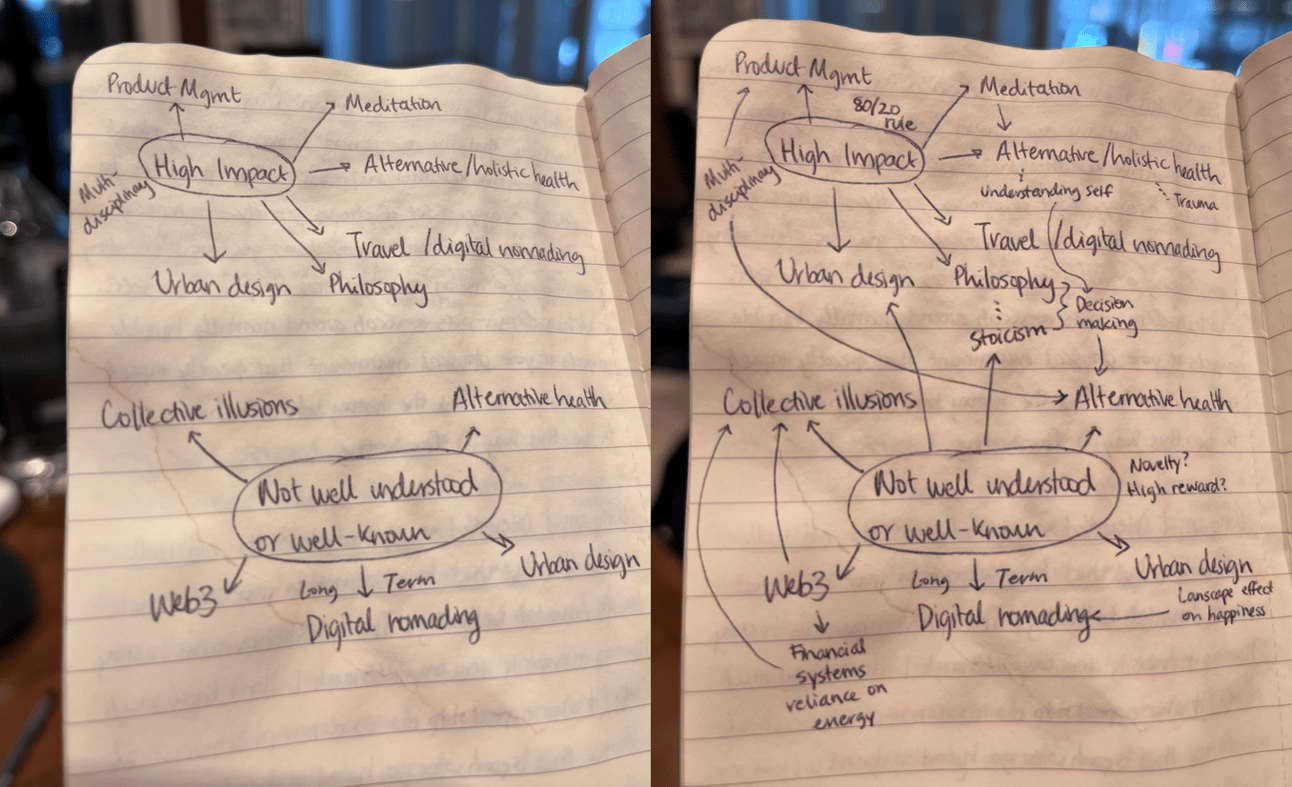
This is a doodle sesh when I was trying to figure out the connecting dots between the topics I discuss in my newsletter. (If these topics sound interesting to you, you can check it out here.)
Which photo looks more robust? The one with clean, single-direction lines or the mangled net of interconnected thoughts and concepts?
My brain tends to like clean lines, so I really had to push myself to keep drawing connections to get to the image on the right.
The more deep neural connections we make, the more durable the knowledge.
3. Reflect via journaling
Journaling is one of those things that we should all be doing anyway, for a myriad of reasons (ikyk): understanding thyself, getting clarity on a tricky problem, goal setting, strengthening a memory, or keeping track of your thoughts and life events.
Everyone agrees we should all be journaling more, but not all journaling is the same. You can have a really valuable journaling session or you can just have a meh session where you don’t walk away with much.
After looking back at some of my older entries (highly recommend), I noticed that much of my journaling was pretty surface level, and I tended to write about the same topics and questions without making much progress.
Then one day I was listening to a podcast between Seth Godin and Tim Ferriss where they were talking about some of the questions they ask themselves to refocus on the things that are most important to them. I paused the podcast and tried to answer those questions for myself.
The result was… really good.
I was pausing a lot more, really thinking and putting together new puzzle pieces before I put pen to paper. The results of that journaling session were way richer and more nuanced than my previous entries. That was an important reminder in the importance and power of asking good questions.
But it can be hard to know what questions to ask yourself.
So as any good AI-fearing millenial would do I asked ChatGPT4 for some starting points, and the answers were pretty dang good.

ty chatgpt
Pretty good gold mine if you ask me.
Depending on what my goal is, I’ve been rotating these questions when I journal.
The quality of my journaling (and insights from it) has skyrocketed.
What NOT to do
I think you get the picture so I’ll keep this section short, but sometimes it helps to talk about what not to do in order to better understand what to do.
I’m pulling from one of the mental models here called inversion. See? Applying what I learned!
Learn superficially: Avoid memorizing facts without understanding their deeper implications (AKA how most schools teach you how to learn). True knowledge integration involves grasping the underlying concepts and their interconnectedness.
Be closed-minded: When someone challenges your opinion, are you silently waiting for your turn to talk, or are you able to see if your existing beliefs and mental models need to shift?
Overlook relationships: When you learn something new, do you look for relationships between new and existing knowledge? Do you over-compartmentalize “work” knowledge and “non-work” knowledge (or whatever the categories may be for you)? Knowledge silos == fragmented understanding. Always seek to connect the dots.
Neglect application: Do you stop at theoretical knowledge? Actively apply what you’ve learned to real-world situations to reinforce integration and discover practical applications.
This sounds effortful. Why bother?
Personally, I have a few friends who are truly brilliant (like Beren). When I talk with them, I feel more awake.
Awake to the levels of understanding that they have, and awake to the extent to which I don’t understand a concept.
No matter what we happen to be talking about, these people have a very durable and connected understanding of how things work.
They typically are very intellectually curious, have a good understanding of how they learn best, and they have a strong grasp of the fundamentals (whatever they may be) that allows them to encode new information very effectively.
What could this type of learning and knowing unlock in my (your) life? How would it actually make a difference in my (your) day to day?
I think it’d be a game changer.
Strong knowledge integration, and therefore comprehension, is the foundation to fluid intelligence, to non-consensus thinking, and innovative thought and action.
If you want to build wealth through investing, are you going to invest in what everyone is investing in? If you’re building a product or a company, are you building something that lots of people are already building right now?
No.
In order to have significant (10x, not 10%) results, you need to zig when others zag. You need to think creatively, to know how to make high conviction, non-consensus decisions.
Personally, this is why I’m investing energy into this skill. It’s foundational, cross-functional, and makes my understanding durable in an age where everything is constantly changing.

credit to @raffaelmiribung
Thanks for reading! If you know of anyone else who would enjoy this newsletter, please consider sharing this with them.
Until next time ✌️
Reply