- Ally's Newsletter
- Posts
- Experimenting with alternative medicine to get out of fight-or-flight mode
Experimenting with alternative medicine to get out of fight-or-flight mode
An unexpectedly good ROI in my mental and physical health

Ally Mexicotte
November 07, 2023

Okay guys, last week we talked about alternative health avenues and why I felt like this is something I needed to try.
After doing my research, I decided to jump in and experiment with a naturopath to see if the experience was helpful and worthwhile to improve my general physical and mental health.
The goal of this first session was to calm down the central nervous system and take my body out of fight-or-flight-mode, which most of us are in.
This impacts every decision we make throughout our days, and the cumulative stress can be very unhelpful when trying to be creative, focused, or consistent.
I walked into the session feeling pretty skeptical, but after following up with a few days of research and feeling noticeably more relaxed, I can say that the vagus nerve stimulation was personally very helpful and worthwhile for me.
Muscle testing as a form of diagnosing what was going on in my body has less immediate effects, but mind-boggling nonetheless.
The main takeaway here isn’t that we should all jump ship on conventional medicine to try alternative doctors and treatments - it’s that if your current care isn’t meeting your needs, you do have options to go out and find other doctors and types of care that suits your needs.
And if you’re someone who wants to make better decisions and be more creative but you feel like you’ve twisted yourself into a psychological pretzel with all the mental frameworks, tips and tricks, I might suggest looking into different ways of hacking into your hardware (your body) rather than your software (your mind).
Our physiology is incredibly influential to our mental state, and this experiment with the naturopath showed me first-hand just how influential it can really be.
Vagus nerve stimulation to calm down the sympathetic nervous system
She started by attaching a TENS (transcutaneous electrical nerve stimulation) device to my left wrist and left ear. It’s a small device that delivers low-voltage electrical currents to stimulate the vagus nerve.

She put only one on my left wrist, this guy is loaded up.
The vagus nerve initiates ~80% of your body’s ability to relax, so stimulating this nerve takes your body out of fight or flight mode.
All of this helps relax the muscles, calm the nervous system and increase blood flow1 . It also decreases inflammation, improves circulation and lymph flow, reduce muscle tension and reduce pain2 .
She then took a microcurrent point stimulator (which is basically a pen version of the TENS machine) and applied a small current to various acupuncture points in my body.

Yum.
I didn’t feel anything at first, but within 15 minutes I was so relaxed I felt like I had 2 glasses of wine.
Within 30 minutes, I was so relaxed that my eyes were gently closing and I had to struggle to keep them open.
I felt so relaxed that I could have gone to bed right there if she had given me a blanket.
This relaxation stayed for a week or two and I noticed myself making better decisions at work as a result. Since I had such a great experience, I’ll be doing more research to find longer-term options.
Muscle testing through the Brimhall Protocol
She then introduced me to the Brimhall Protocol, where the basic premise is that you can test muscle strength to as a diagnostic tool to uncover hidden problems in the body.
The idea is that the central nervous system turns muscles on and off due to a variety of stimuli like stress, hormones, toxins, electromagnetics, and a lot more.
The practitioner asks the body yes or no questions and does a quick muscle test to see if strength gives out or holds strong after the question.

This is a visual representing one of the positions she tested on me
If you think that’s weird hold tight because it gets even more interesting.
She asked me to hold out my right arm and repeat after her and say “the sky is blue.”
She pulled down on my arm and it didn’t budge much.
Next, she instructed me to do the same thing except say “the sky is green.”
She pulled down on my arm and my arm lowered maybe a tiny amount more.
Her rationale for why this happened is that the central nervous system (CNS) is able to turn muscles on or off as a result of various stimuli or disturbances.
She used this diagnostic method for the majority of our session, asking my body yes/no questions and testing different muscles (mostly arms and legs held at odd angles).
I was (still am) definitely pretty skeptical about this particular technique - it was hard for me to see a big difference in my arm dipping at times (other times it was very obvious), and it’s not a very well explained mechanism in part because there are so many stimuli that can affect the CNS.
For example, it’s thought that muscle testing can indicate food or supplement sensitivities by indicating whether the body considers that food or supplement to be a toxin.
As an example of this, she tested one of my muscles and determined that my spleen was weak, so she gave me a certain supplement where I held it in my other hand as she muscle tested the other arm. My other arm held out a little bit better (maybe?) under her test.
When I did my research after our session, finding a clear rationale on why this happens (if it truly does) was difficult.
It’s true that our bodies are an electromagnetic field and that outside objects can affect our energy and our electromagnetic field, but I don’t pretend that I understand the in’s and out’s of this quite yet.
This is about the time when I start wondering if I’ve just spent a pretty penny getting swindled.
… until I looked at the research.
Is this an actual thing?
I was pretty ready to go on the internet and be told by WebMD that I’m an idiot for asking my body yes/no questions and expecting it to pipe up with a response.
Instead, I was absolutely flabbergasted by the number of studies out there that validated it’s effectiveness as a diagnostic tool.
In fact, a lot of studies seemed to skip over the point of whether or not it worked and were more focused on how to do it more accurately (e.g. by using various tools or measurements).

Another study giving cautious verification that manual muscle testing can be a clinically useful tool:
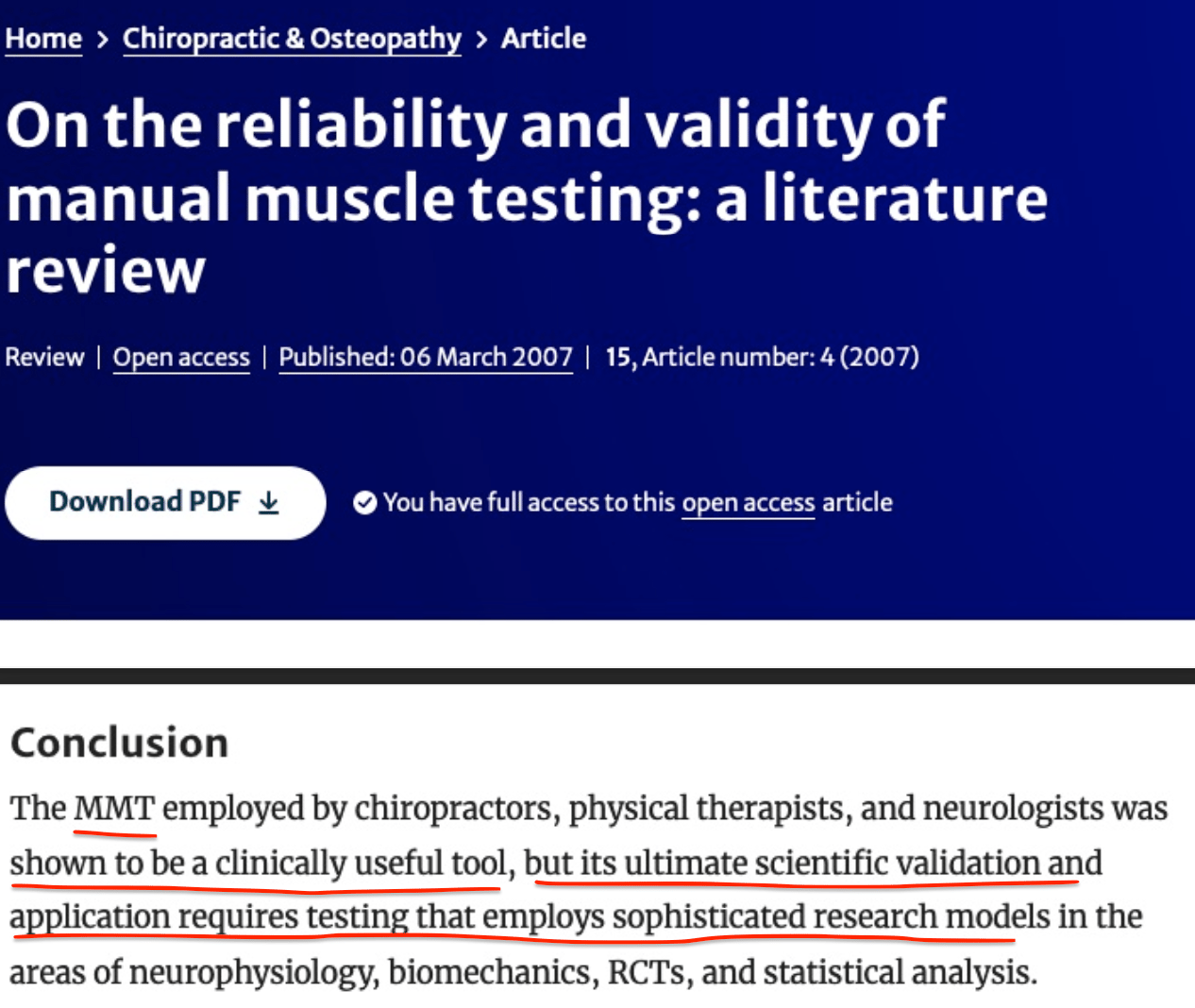
Feels like research-speak for “it works but make sure you don’t get carried away with it”. MMT stands for manual muscle testing.
I did find some studies warning that the accuracy of muscle testing to be around 80%, which was interesting.
If I had a very serious life threatening illness, 80% accuracy might not be as high as I’d like, but I’m more in the optimizing-for-health arena currently so I’m pretty thrilled about 80%.

idk I feel like 80% is pretty good guys
I’m still a bit in shock that this is a real thing.
There are limitations to what you can test with muscle testing, though.
Muscle testing does not give a good indication on psychometric assessments like personality traits, behavioral style, aptitude, intelligence, which makes total sense.
It’s a physiological and neurological test, not a mental one.
Her diagnosis also checked out with my medical history
Last but not least, I reviewed the results of her analysis of my body to gut-check whether I thought they were plausible or accurate.
In the interest of keeping my medical history private, I won’t share it here, but there were a few items on the list where she was spot on, and I hadn’t told her about those things.
I’m still not totally convinced of this method, but I’m committed to experimenting for at least 3 months to see if I can experience any notable changes in my health.
tl;dr
Sooo today we found out that you can ask yes/no questions to your body and the damn thing will talk back and answer you.
If that isn’t wildly insane I don’t know what is.
The main takeaway here isn’t that we should all jump ship on conventional medicine to try alternative doctors and treatments - it’s that if your current care isn’t meeting your needs, you do have options to go out and find other doctors and types of care that suits your needs.
This is a space with relatively higher risk - seeing a bad doctor who tells you to do things that actually hurt your health is a real risk - but as someone who’s willing to fact-check what I’m told, it’s a very learning-rich and empowering experiment.
Reply