- Ally's Newsletter
- Posts
- What should education look like when we know 70% of our jobs will be automated in the near future?
What should education look like when we know 70% of our jobs will be automated in the near future?
4 traits of education for the metaverse generation

Ally Mexicotte
September 14, 2023
You guys!
You are actually sharing this lil newsletter with people - thank you!
It feels so cool to make things in my mind concrete and real by putting them out into the iNTErNEt and know that someone other than my younger sister, best friend and her husband are reading this (although ty to my Day Ones, never forget!).
We are now a whopping party of 18 people. I appreciate you. So much.
When I started this newsletter, I wanted to make sure that I was consistent in writing so I made a potential end date. A planned existential crisis if you will.
How did I create drama in my own life, you ask?
What a fun little game! Anyway, now you’re part of it, and it’ll be a fun little experiment.
Thank you for sharing this newsletter (only with people who you think will genuinely have fun with it), and don’t forget to vote yay/nay when I put the poll out at the end of the year.
If it dies, it dies. But I’m working hard so it doesn’t, and it creates a sort of gamified challenge for me to get creative with how I can get buy-in so enough people see value in this continuing.
No matter how it turns out, it’s already a smashing success because I’m having a lot of fun writing for you.
P.S. Since the life of the newsletter is in your 18 sets of hands, don’t be afraid to give me constructive feedback in the comments section I enabled. I might also send out a 4 question feedback form if you’d prefer staying anon.
✌️
What should education look like when we know 70% of our jobs will be automated in the near future?

Credit to Emma Bauso
Recently I did something creative that felt like I broke some rule or did something without permission - and it was super fun. And I remember thinking to myself, why does it feel like I did something not allowed?
I think it was because it was a bit unconventional and unexpected. Which then made me ask, where did I pick up this internal boundary?
I think it was, at least in part, due to the state prison I served at for 12 years.
Just kidding. I am, however, seriously referring to the school system that does a pretty good job of squeezing out individuality, curiosity and creativity.
School teaches us to passively wait for the lesson plan and grit our teeth through predetermined schedules rather than listening to our individual inner voices of curiosity. How are we supposed to wake up after 12 years of obediently optimizing grades to pick a major in college or a career path?
We’re now on the exponential part of the curve of change. If school didn’t serve me, it’s sure as hell not going to serve my kids living in the metaverse.
What’s the alternative?
I was looking at some alternatives - homeschooling, microschooling, unschooling, online learning, Montessori schools, and Waldorf schools.
Really interesting to see these other options, and I think there’s more than one answer, but I’m less interested in debating methodologies and more curious about what are the underlying traits that make a good system for learning.
There are 4 traits that I think any successful educational experience needs to include:
Designed to the Edges: personalized to the needs, abilities, interests of the smol person.
Practiced Introspection: helping smol people unearth what they are good at, and what they are not as good at.
Curiosity-Led: as opposed to curriculum or memorization-based. This is critical to do the one thing humans have an advantage in over robots.
Mastery in Leveraging Technology: “Success will go to those who best optimize the process of working with bots and machines.” -Kevin Kelly.
1. Designed to the edges
Our current school system educates each student in the same way. It hasn’t changed much since the industrial revolution, when schools were basically out churning out obedient people who would work in factories.
When we teach children (or adults) in a lecture and test-based environment, the physical and digital learning environment is a very one-size-fits-all approach. And we’re falling into the Myth of Average.
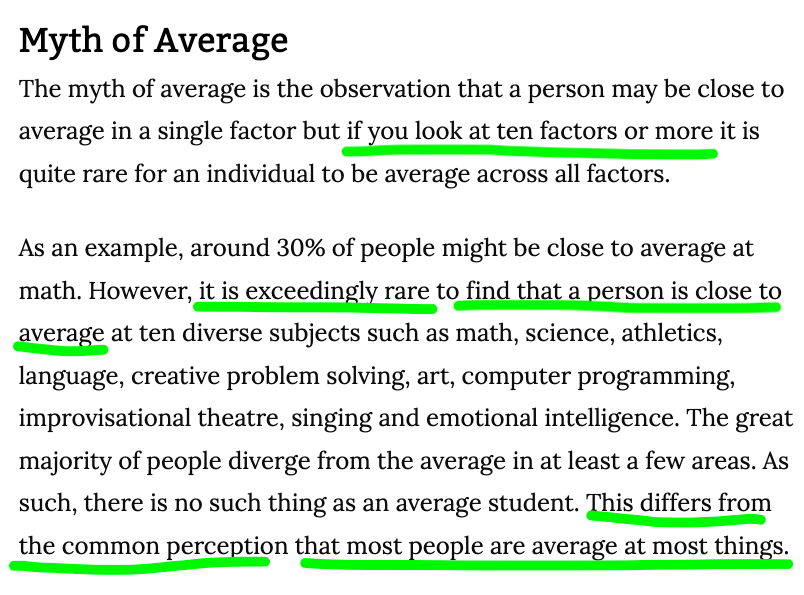
This is part of the reason why some parts of education are categorically good use cases for AI - because education is complex, requiring much more than a combination of ten factors to do well, and because one of the advantages of AI is the ability to personalize content.
How do you design for the edges? You figure out what the edges are. What does a lesson plan look like for someone who has a really slow processing speed? Or a really fast one?
Without AI, we couldn’t afford to create auditory content for the auditory learner, visual content for the visual learner, and so forth.
But now, we can.
2. Practiced Introspection
Not only is it obviously important to know yourself to live a fulfilling life, it’s also essential to figure out one’s career in relation to an ever changing technological landscape.
You gotta know what you’re good at and what you’re not.
Double down on what your unfair advantage is, then leverage tech (or other resources) to compensate for your weaknesses.
As AI gets increasingly intelligent, one of the skills that humans have and machines don’t is the ability to decide what problem we humans want to solve next.
When machines automated creating goods during the industrialization age, we saw an increase in the number of full-time musicians, athletes, fashion designers, fan-fiction authors, ballerinas, and all sorts of unique careers.
On a mass scale, the automation freed up humans to do activities that are better suited for humans. The change wasn’t easy, but it did happen.
Each invention will lead to new problems to solve, for which humans will solve, then eventually employ robots to solve, and the human will find new problems or opportunities to optimize, and the cycle will continue.
3. Curiosity-Led
You don’t need to be a parent to understand that kids are curious cats and they’ll be more excited to learn when it’s about something that’s relevant and exciting to them.
When kids say they’re not interested in reading, even if they have the skills, it’s likely because we haven’t tapped into their intrinsic interests or needs. I’ve seen this with my 6-year-old son — he has above-average reading skills, but when asked to focus on reading simple narratives, he often shies away.
In contrast, when allowed to choose books about species of snakes or sharks, his favorite animals, he brings books to the dinner table and often asks, “is this the right way to read this?” or “Hold on, I didn’t get this word.” Even with books far above his reading level, he wants to engage and give it a try.
Curiosity-led learning is the only way to truly learn because it means that there’s a desire to understand what’s going on.
It’s critical to knowledge integration (building a durable understanding of how things are connected) and the foundation for the ability to make first principles decisions.
Curiosity is inherently creative, another skill set more suited to humans. AI can generate art, but it’s heavily dependent on its training data set and is biased towards following rules and patterns.
4. Mastery in Leveraging Technology
When ChatGPT first came out, do you remember your reaction? I remember mine.
It was “huh, how the heck do I use this thing. Not sure how it can help me in my critical thinking job.”
Fast forward, I use it almost daily in my head of product role.
It takes practice interacting with tools, knowing what’s possible and knowing what tools are even out there in order to be able to efficiently accomplish your goal.
If you’re a podcaster but you didn’t know that there was an AI tool that could learn your voice and record podcasts for you (this exists today), you might have less time than your competitiors to optimize some other part of your business.
Or let’s say that you know about ChatGPT but you didn’t think to use it for unusual use cases (like creating a travel itinerary) because you’re just not used to experimenting with the tool.
The same tools are accessible to most of us who speak English and have access to Internet, but those who use those tools in creative ways will have an advantage.
tl;dr
In the face of so much uncertainty and an insane rate of change, education will need to have these 4 traits:
Designed to the Edges
Practiced Introspection
Curiosity-Led
Mastery in Leveraging Technology
It won’t be easy, but we’ll get there 🙂
Photo of the day

… for now
Quote of the day
“To a disciple who was forever complaining about others, the Master said, ‘If it is peace you want, seek to change yourself, not other people. It is easier to protect your feet with slippers than to carpet the whole of the earth.’”
Anthony de Mello
Thanks for reading! If you know of anyone else who would enjoy this newsletter, please consider sharing this with them.
🌈 ✨
Reply