- Ally's Newsletter
- Posts
- Collective illusions
Collective illusions
Non-consensus decisions, trust and pain au chocolat

Ally Mexicotte
August 22, 2023
gm gm.

Welcome back to this fluid, undefined experiment of a newsletter about creativity, critical thinking, learning, and taking bets on how to live a fulfilling life that’s aligned to your actual values.
Today we’re digging into a really interesting topic related to non-consensus thinking.
Non-consensus thinking has been a bit of a reoccurring theme in my life lately when asking myself the larger questions around “what is life” and “what am I doing with it.”
Non-consensus thinking is difficult and powerful because
1) it’s hard to disagree with the majority - by definition, most people will think you’re wrong, at least initially
2) you need to have a first principles understanding of the topic in order to construct a strong non-consensus opinion
3) you need to have high conviction AND know when to go against the grain.
When you read about non-consensus decisions, it’s typically in the context of VC investing.
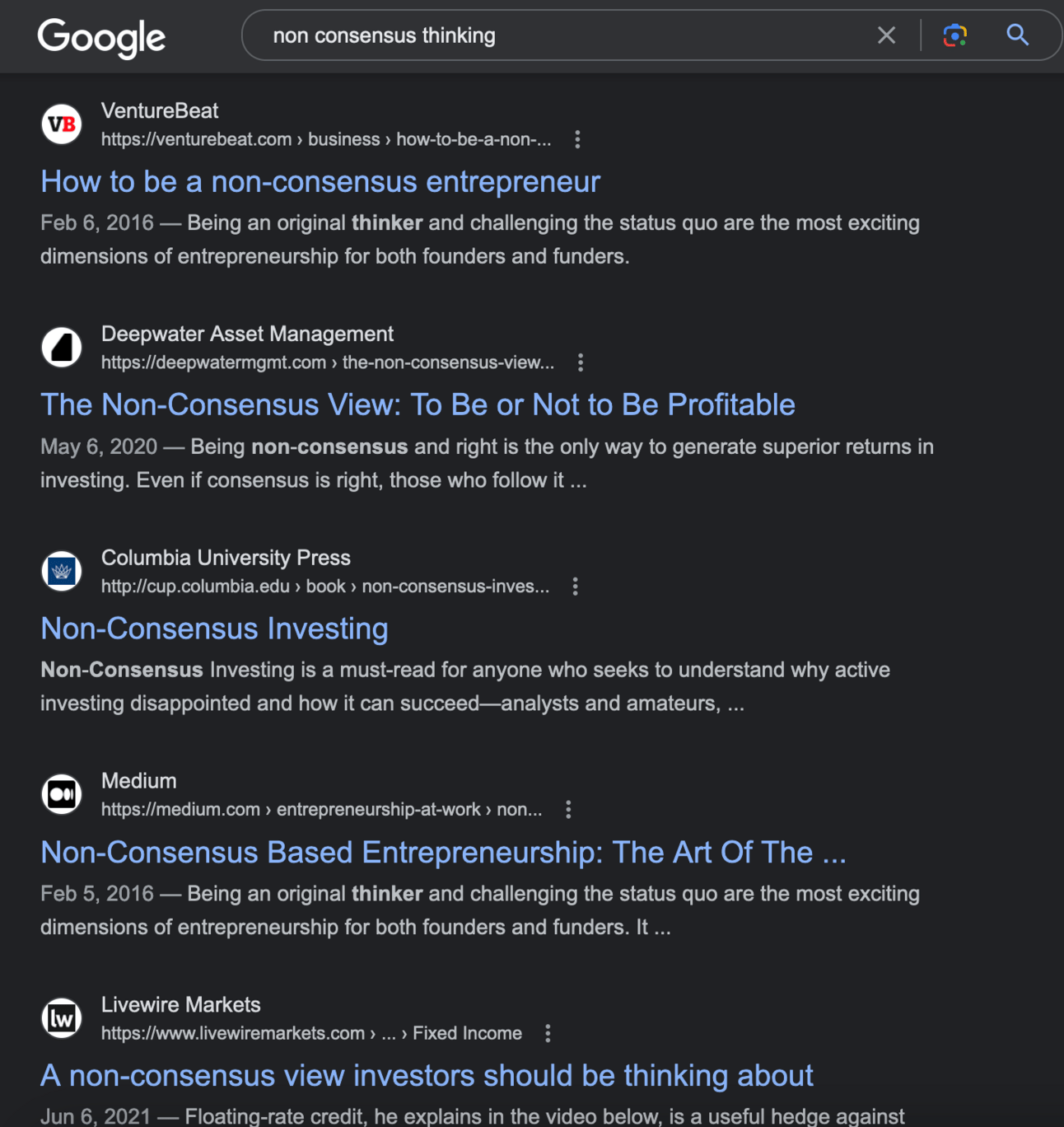
VC bros up in here
But actually, it’s an incredibly important skill to keep living a life that is in alignment with your values or stop living a life that isn’t.
And no matter how smart I think I am, when I am constantly being bombarded with what to be, buy, and think, I need to take a breather and break out of the marketing bubble that is the year 2023.

tell em Judy
Collective illusions
What are they?
A collective illusion is a situation where most people in a group go along with an idea that they don't agree with, simply because they incorrectly believe that most people in the group agree with it. The majority of people in a group believe the majority thinks something that they don't.
They lead individuals to make decisions that are contrary to their private values. And as a result, the entire group can end up doing something that almost nobody wants.
That’s insane.
How can that happen? Former Harvard professor and think tank founder Todd Rose presents the argument that it stems from our deep rooted desire to fit in.
As deeply social creatures, humans need to belong to communities to survive, but today, our communities are dispersed, virtual and often mediated by social media.
Most of us would rather be fully in sync with the social norms of our respective groups than true to who we are.
And there’s a ripple effect that goes beyond ourselves:
The most damaging consequence is that an illusion in one generation tends to become the private opinion of the next generation.
So how do we stop collective illusions from taking further hold in our minds?
We get offline and have conversations with people.
When you have a choice between trusting people and control, create a mini experiment for yourself and choose trust. See what happens.
Share your honest thoughts even if it goes against what you think might be a consensus opinion. Hear others’ opinions out.
The beautiful thing is that Todd and others have run experiments testing what the average person believes, and it inspires far more hope and probably aligns with your own values way more than you would expect. It’s our false perception that makes everything feel more bleak than it actually is.
One of the implications here is that reality may actually be more optimistic than our predictions, and that we as a society are actually more united than we could ever believe in the time of social media.
Unity for the sake of unity is false consensus. We don’t want to paper over real differences. What we want is a culture where we treat each other with respect so we can adjudicate those differences in productive ways.
I recommend watching this teaser 4 minute video below on collective illusions. If you’re curious to learn more, here’s the full length video that goes into a deeper dive (highly recommend if you’d like to understand this concept further).

Photos worth pondering


Thanks for reading! If you know of anyone else who would enjoy this newsletter, please consider sharing this with them.
Until next time ✌️
Reply