- Ally's Newsletter
- Posts
- How to understand how the world works and how you fit into it
How to understand how the world works and how you fit into it
A cheat sheet on knowledge scaffolding

Ally Mexicotte
December 05, 2023

In order to make good decisions, understand how the world around you works, and how you fit into this world, it’s extremely helpful to have a durable baseline understanding of the world.
This baseline is like the scaffolding of a building — it’s a rough outline that makes it easier to slot the next brick.
We can’t know everything there is about everything, so how does one develop a durable understanding of the world?
We build a knowledge scaffold that’s highly multi-disciplinary and interconnected.
Mental models are the shortcut to building this scaffolding.

This knowledge scaffold should outline what will be the same in 100 years instead of what will be different, and its strength comes from being interdisciplinary, as opposed to being specialized and siloed.

Which knowledge structure is stronger?
Luckily for us, this has already been mapped out for us by Farnam Street.
And I’m genuinely thankful for this article because there are 9 different disciplines of mental models and 92 well-known mental models to cover.
Quoting my boy Tommy (others know him as Thomas) Edison, “I regard it as a criminal waste of time to go through the slow and painful ordeal of ascertaining things for one’s self if these same things have already been ascertained and made available by others.”
The 9 disciplines of mental models
According to Farnam Street (which is a highly reputable source that I very much respect), there are 9 big disciplines of mental models to know.
They are:
General Thinking
Physics and Chemistry
Biology
Systems
Numeracy
Microeconomics
Military and War
Human Nature and Judgement
You might think to yourself, “I’m sure as hell not a physicist or chemist, so I’m going to skip over that category.”
But what about the concept of velocity?
It’s the idea that instead of only thinking about the speed of an object, you should also consider the direction.
If you have a side hustle or a business that you’re trying to achieve an outcome with, for example, the concept of velocity reminds us that progress towards the goal (direction) is more important than pure speed.
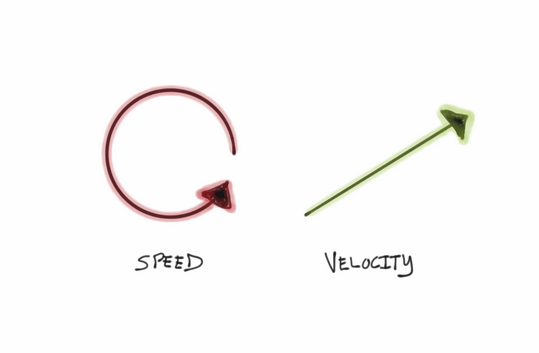
Velocity takes into account both speed and direction. If you only measure speed, that’s called going nowhere fast.
The mental model of velocity puts a name to a struggle that every single person experiences when your coworkers/boss/direct reports rushes the team towards the wrong solution.
And it comes from physics and chemistry!
A quick overview of all the mental models
Given that there’s an easy 92 of these bad boys, I’m regretfully not going to type them out as they are already in existence here.
But I did painstakingly type out a summary of them just to see if you could recognize any:
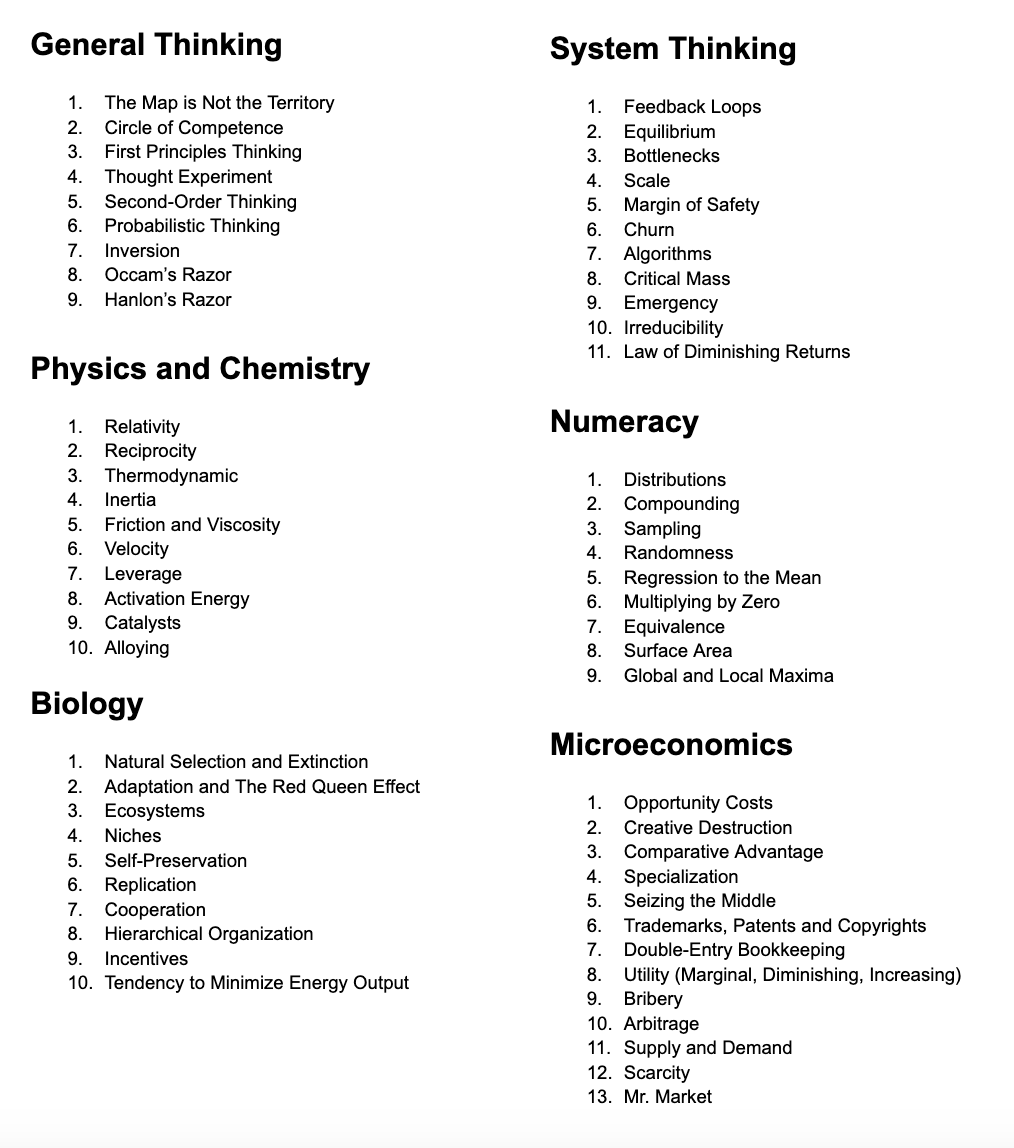
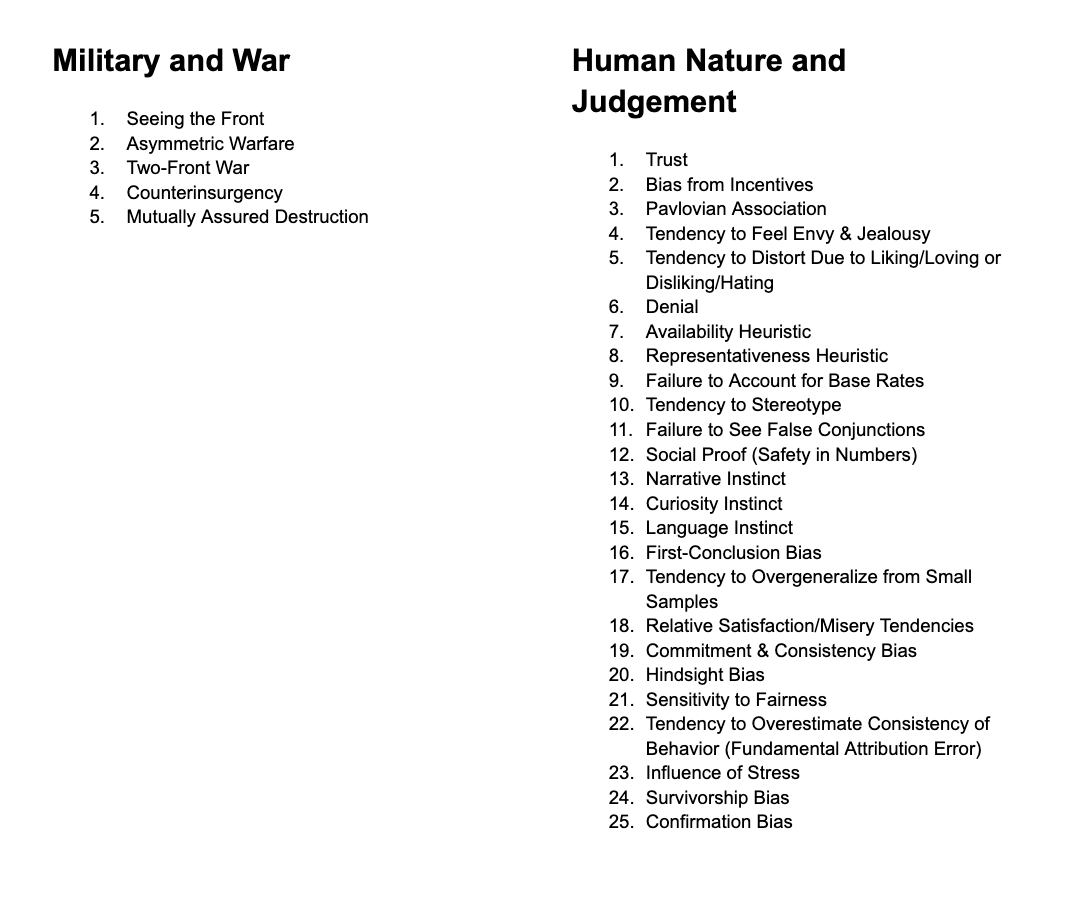
These have strengthened my thinking and decision making skills so much that I’m seriously considering making 92 flash cards.
Are mental models really going to improve my ability to think critically and make decisions that much?
Yes my dude. It literally gives us the playbook of all the patterns that keep repeating themselves across the world through time and space.
The world is complex and wide-ranging. These models are a cheat sheet for patterns to recognize and build upon. It gives language to abstract concepts, and provides the frameworks for an organized knowledge structure.
Organized knowledge structures allow you to store and retrieve knowledge much easier and faster, and it’s often what differentiates how experts vs. novices think.
Don’t be a novice. Go read.
Reply