- Ally's Newsletter
- Posts
- 84%


I imagine that man on the right is an influencer
My founder and I were brainstorming how we could build an app that would better prepare high schoolers with real-life skills like personal finance, nutrition, voting, and tech ethics but we got on a bit of a tangent talking about social media.
His daughters are in middle school and they’re not yet to the point in life where they’re interested in compounding interest rates.
“All these kids want to become influencers, but they don’t realize what kind of trap it actually is. The fame, the constant sharing of your own life - all social media is actually a video game. Everyone wants to be the hero in the game, but no one actually realizes that the majority of actions in the game are done by NPC’s (non-player characters),” he said.
“What do you mean, ‘most of the actions are done by NPC’s’?” I asked.
“Well, when you’re on a quest in a video game, there are a thousand trolls you might need to slay as the hero. Those trolls aren’t real players, because they exist to be slayed by the hero. The same thing goes for social media, the biggest video game of them all - many of the insensitive comments that make you comment back and get all flustered are bots. Often times those trolls aren’t human. They exist to get a rise out of people, and they have a short life because those accounts get reported and blocked.”
Okay, yeah I get it, we have bots, I thought to myself.
He leaned in. “Twitter has already admitted that 5% of its users are bots, and bots can post a couple hundred times an hour before they get flagged. A normal human usually doesn’t post even 20 times in an hour. So even if only 5% of your users are bots, if bots are conservatively 100x more active than a human user, 84% of the content on Twitter comes from bots.”
I sat stunned.
That can’t be true, I thought. I follow influencers on Twitter and Instagram and I know they’re real. But the comments section…
So I fact checked the variables he listed.
Here’s where a 3rd party data analysis firm (hired by Elon before he bought Twitter) confirmed with 90% confidence that 5.3% of users are bots. Here’s X’s policy that states an account can make 2,400 posts a day with hourly limitations.
And here’s where I asked ChatGPT to show the math:

even better than a calculator imho
This is truly insane. Not only is this technology designed by our best and brightest to be addicting, the content on there is vastly skewed by whoever controls the bots.
“Who’s creating the bots?” I asked him.
“Any group with resources and an agenda,” he replied. “Every social media platform struggles with the bot issue because there are mixed incentives - each platform wants real users, but they also need to show their investors steady user growth. I know this because we had the same issue at Flipagram.”
Flipagram was the company he sold to ByteDance, where it was combined with a couple of other apps to become what is now known as TikTok.
The ability to add your favorite soundtrack to your videos? He created that.
I don’t think he could have foreseen how his app would be used, how much it would blow up and change the world that we live in today.
If I had to guess, it’s a big reason he’s shifted his focus entirely to build non-profit tech for good.
In a previous newsletter, we talked about collective illusions and these bots amplify this concept by 1,000x.
Quick recap on what collective illusions are:

Collective illusions are problematic because they lead the entire group can end up doing something that almost nobody wants.
That’s the definition of a lose-lose situation, guys.
This is a big no-no.
Seriously, think of the magnitude of what we’re saying - millions of bots running around making shit up (controversial shit, mind you, not like speculating-whether-Martha-Stewart-got-a-face-lift type shit) of things we might not even be able to disprove. Things like public opinion.
Fake public opinions (aka collective illusions) are similar and related to the fake news issue, except with with fake news you can usually get to the bottom of whether a political action clearly did or didn’t happen.
What we perceive public perception to be is less straightforward and depends on our online third spaces.
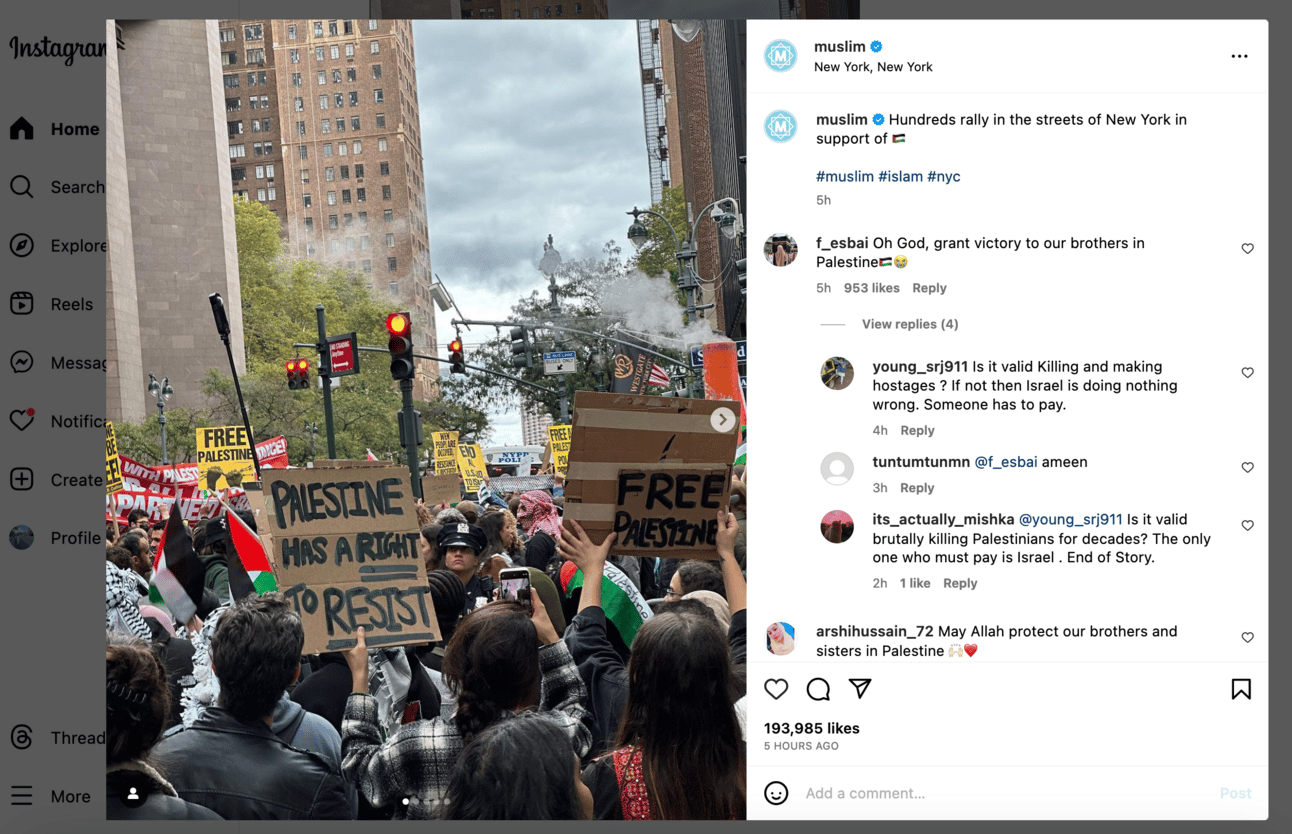
comments sections are like the taverns (or other third spaces) in the digital age
With Palestine and Israel at war, the above screenshot is a real example of how comments sections can quickly turn into dangerous spaces.
How can we know if a comment is written by a person, or a bot meant to inspire hate or some other political end?
What happens in comments sections does not, in fact, stay in comments sections.
So, what can we do?
Should social media platforms prioritize verifying accounts?
Is it right to charge for the ability to show that you’re human or that you are who you say you are, or should we be incentivizing verification more?
Can we change incentive structures for social media platforms to be oriented towards quality engagement rather than pure growth in number of comments and users?
I don’t have the answers to these questions right now, but for now my biggest takeaway is to be optimistic and give the benefit of doubt to other humans.
Why?
How many times have you made small talk with a complete stranger/Lyft driver/person at a bar and walked away thinking, that person was completely nuts-o.
Idk about you but it doesn’t happen that often to me.
Chances are, the human next to you has some basic common sense, friends, family, their own values, and their own life experiences.
It’s terribly unhelpful to assume that everyone (except you) is dumb, but it can certainly seem that way when we read countless comments and posts that say otherwise.
Just keep in mind that posts, comments, and other user-generated content online is not a 1:1 ratio with the number of people posting them. One post does not always equal one person’s opinion, because a smaller percentage of people (they’re called influencers for a reason) and institutions are creating a vast majority of the content we’re exposed to online, bot or not.
When I see a comment online that triggers a flight or fight response in me, I take a second to consider that the comment may have been made by a bot trying to get a rise out of me.
Keep calm, carry on, and spend time with real people to regain trust in humanity.

Todd’s harmless tbh he just had a little too much root beer
Another one in the books! Thanks for reading all the way until the end.
If you felt like this article/newsletter was valuable to you, the best way to support this work is to share it with someone who you think would genuinely enjoy it.
Until next time,
🤖
Reply